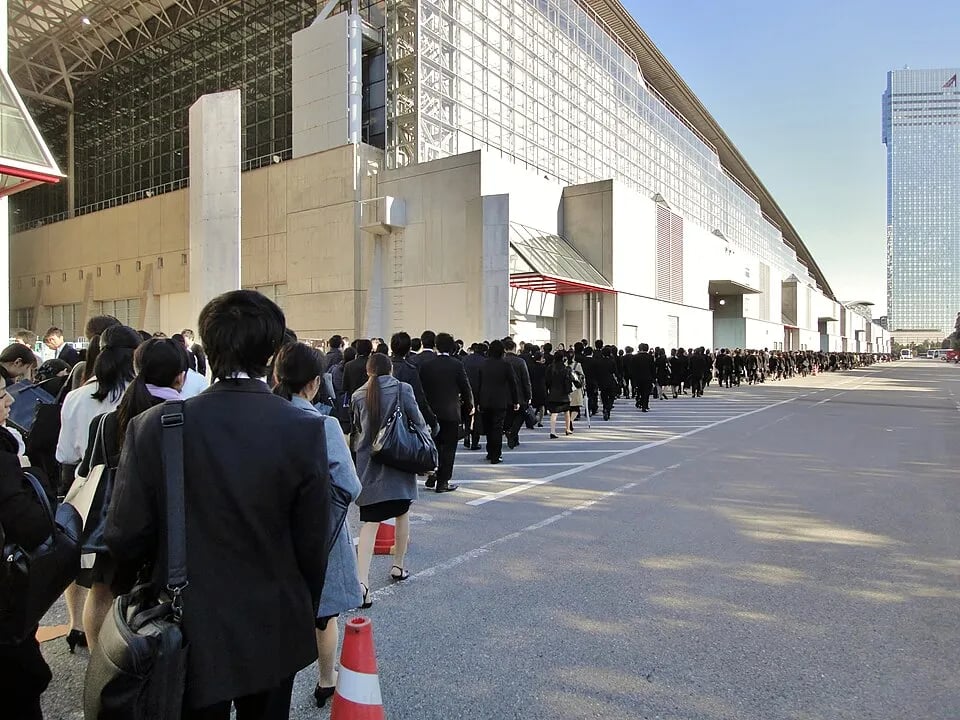
Shukatsu: Japan's Synchronized Graduate Job Hunt
Created by Brando Oxley · 22 Aug 2026
Key Vocabulary
a hiring system in which many employers and applicants follow a similar timetable
Synchronized recruitment concentrates applications into a shared season.
recruiting a large group of new employees during the same cycle
Bulk hiring allows companies to train new graduates together.
a structured written application used in Japanese graduate recruitment
Applicants use the entry sheet to explain motivation and experience.
an assessment intended to measure abilities relevant to selection
Many applicants prepare specifically for the aptitude test.
an early notice that an employer intends to hire a candidate later
A preliminary offer can arrive before a student graduates.
Article
In many labor markets, graduates apply for openings as particular jobs appear. Japan's shukatsu, or graduate job-hunting process, has traditionally been more synchronized: large numbers of students and employers move through recruitment stages on a broadly shared calendar before students have actually graduated. [1][2]
One defining feature is bulk hiring of recent graduates, known as shinsotsu-saiyo. Companies recruit students who expect to graduate the following spring, and successful candidates commonly enter employment together in April, immediately after the March end of the university academic year. [1]
The process asks students to translate their university experience into a standardized recruitment language. An entry sheet may require concise written explanations of motivation, personal strengths, setbacks or past activities, often within strict character limits. For applicants, producing an effective entry sheet can become a substantial exercise in self-presentation. [3]
Selection commonly continues with an aptitude test and multiple interviews. Written assessments may cover Japanese, mathematics, English or related abilities, while interviews allow companies to judge communication, motivation and perceived long-term potential. [1][3]
A preliminary offer can arrive months before formal entry into the company. The timetable therefore creates an unusual overlap: students are still members of a university while simultaneously passing through a recruitment system designed to place them into the next cohort of corporate employees. [1][2]
This synchronized recruitment has practical advantages. Employers can plan a predictable intake and provide training to a group of new employees together. Students, meanwhile, can compare many employers within a recognizable annual cycle. Yet the same concentration of activity can make timing consequential, especially for students who begin late or who are unfamiliar with the system. [1][4]
International students face an additional layer of adaptation. Study in Japan and JASSO publish detailed guidance precisely because understanding the sequence of company research, applications, written screening, tests and interviews can matter almost as much as understanding an individual vacancy. [1][4]
Shukatsu is therefore more than a collection of job applications. It is a coordinated transition mechanism between education and employment. Its distinctive pressure comes from that coordination: thousands of personal career decisions are made inside a timetable shared by universities, employers and an entire graduating generation.
Discussion Questions
- How does synchronized recruitment affect the freedom students have to explore different career paths?
- What does an entry sheet reveal that a conventional résumé may not?
- When is an aptitude test a useful selection tool, and when might it exclude strong candidates?
- What advantages does bulk hiring create for employers and new employees?
- How could Japan make the path to a preliminary offer easier to navigate for international students without removing the system's structure?
References
Finished reading? Mark this lesson as done.