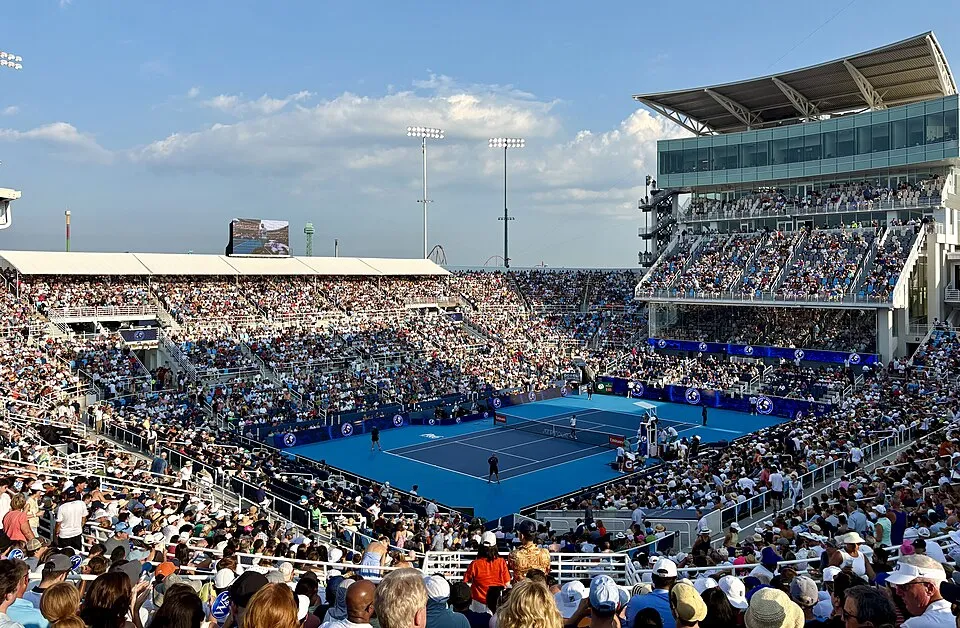
A Bigger Stage in Cincinnati: How a Combined 1000 Event Works
Key Vocabulary
a competition that combines separate professional tours or categories within one event
Cincinnati operates as an integrated men's and women's tennis event.
the amount of land measured in acres
The venue's acreage roughly doubled during the expansion.
the rewards and consequences connected with a competition
Ranking points raise the sporting stakes for top players.
a situation in which many important events are scheduled close together
Calendar congestion can make recovery difficult for professional athletes.
the organized tournament bracket showing who plays whom
The draw becomes smaller as players are eliminated.
Article
The Cincinnati Open, running from August 13 to 23, occupies an unusual position in professional tennis: it is simultaneously an ATP Masters 1000 and WTA 1000 event, placing high-level men's and women's competition on the same grounds during a crucial part of the North American hard-court season. [1][3]
Its scale has changed substantially. Organizers invested about $260 million in a transformation of the Mason, Ohio, campus, roughly doubling its acreage and enabling 96-player singles fields. [1] The expanded format means more early-round matches and a broader range of players for spectators to see.
At the 1000 level, the sporting stakes are substantial. Players can earn up to 1,000 ranking points, and the women's tournament lists more than $7.4 million in prize money. [2] Those rewards help explain why Cincinnati attracts elite fields shortly before the US Open.
The timing also creates a tactical challenge. Players must adjust to outdoor hard courts, summer heat and a crowded calendar while deciding how aggressively to pursue results before the year's final Grand Slam. Success may depend as much on recovery and scheduling as on shot-making.
For spectators, the combined structure produces its own rhythm. Early rounds can involve a dense schedule across many courts, encouraging fans to move around the grounds rather than remain in one stadium. Later, attention concentrates as the draws shrink toward the August 23 finals. [1]
The modern Cincinnati Open therefore illustrates how top-level tennis is evolving toward larger, longer and more integrated events. That expansion can create richer viewing choices and greater commercial value, while also asking players and fans to navigate a more complex tournament. The appeal may lie precisely in that density: for several days, one venue becomes a crossroads for two global tours.
Discussion Questions
- Does expanding elite tournaments improve professional sport, or can it make the calendar too demanding?
- How should tennis balance commercial growth with athlete recovery?
- What advantages do combined men's and women's events offer compared with separate tournaments?
- How does tournament design influence the way spectators experience a sport?
- What characteristics make a sports event feel important even before the final is played?
References
Finished reading? Mark this lesson as done.