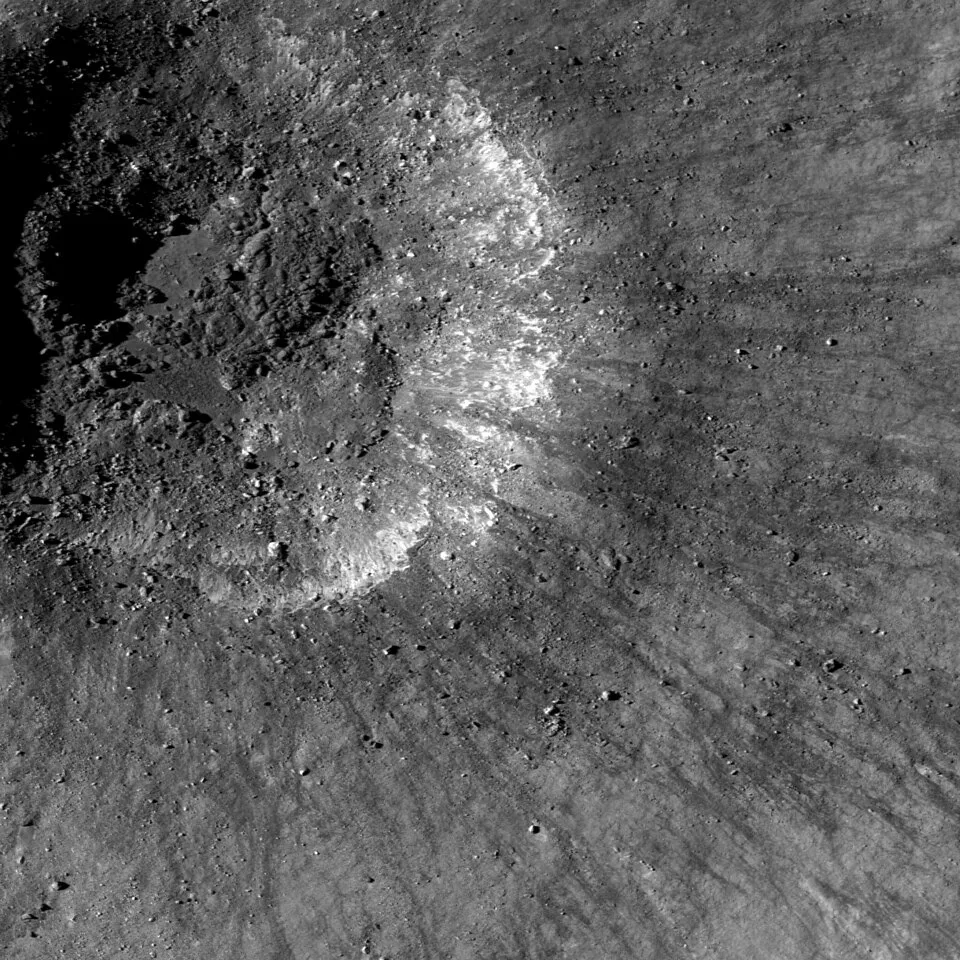
A Rocket Stage Hits the Moon: An Accidental Experiment
Key Vocabulary
the part of a rocket that continues after the lower stage has finished
The Falcon 9 upper stage remained in space after releasing its payload.
the path followed by an object moving through space
Scientists calculated the rocket stage's trajectory toward the Moon.
a collision in which one object hits another
Researchers prepared telescopes before the lunar impact.
rock, dust or other material thrown out by an impact
The collision may have sent lunar ejecta above the surface.
known information used for comparison
The artificial impact gives researchers a useful reference point for future studies.
Article
On August 5, a used Falcon 9 rocket stage reached the Moon after spending more than a year in space. The collision was not part of the original mission, but scientists knew it was coming and treated it as a rare chance to study an artificial impact on the lunar surface. [1]
The stage had launched in January 2025 with Firefly Aerospace's Blue Ghost lunar lander. After separation, the rocket stage entered an unusual orbit influenced by the gravity of Earth, the Moon and the Sun. NASA and SpaceX later tracked it toward an impact site on the Moon's far side, near the Einstein and Bell craters. [1]
Researchers prepared observations before the event. One scientific team calculated an impact time of about 06:35 UTC on August 5 and examined which telescopes and spacecraft might be able to detect the flash, dust or debris produced by the collision. [2]
Another study used telescope observations to identify the object and estimate its physical properties. The researchers predicted that it would hit at roughly 2.4 kilometres per second and could create a crater around 40 metres across. [3] These estimates can later be compared with observations of the actual site.
After the predicted impact, astronomers reported evidence of a brief plume containing elements including sodium and lithium. NASA's Lunar Reconnaissance Orbiter may provide additional information by imaging the area. [4] Scientists can compare what was predicted with what actually happened.
Why study an accidental crash? Controlled experiments on the Moon are expensive, while natural impacts usually happen without warning. An object whose size, trajectory and materials are partly known gives researchers a useful reference point for understanding how impacts create craters and eject material.
The event also has a practical side. More spacecraft are travelling through the space between Earth and the Moon, so accurately tracking inactive rocket stages and other objects is becoming more important. A piece of hardware that had finished its original job unexpectedly became both a tracking problem and a scientific experiment.
Discussion Questions
- What scientific value can come from an accident or unexpected event?
- How much responsibility should space companies have for rocket stages after their main missions are finished?
- What kinds of rules might become necessary as more countries and companies send missions toward the Moon?
- Why is it useful for researchers to compare predictions with what actually happens?
- Which area of space research would you most like scientists to understand better, and why?
References
- NASA, "NASA Will Attempt to Observe Rocket Part's Lunar Impact." Source
- Fernando et al., "Observational planning for the 2026 August 5 Falcon 9 Upper Stage lunar impact." Source
- Campbell et al., "Physical Characterization of Moon Impactor 2025-010D." Source
- Associated Press, "Scientists are certain a wayward SpaceX rocket slammed into the moon as predicted." Source
Finished reading? Mark this lesson as done.