Commerce That Appears and Disappears: The Mexican Tianguis
Key Vocabulary
buying and selling organized for limited periods rather than through permanent shops
Tianguis are a form of temporary commerce.
streets, squares and other spaces shared by the public
Market day changes how the public realm is used.
the front part of a permanent shop facing the street
A tianguis vendor may operate without a conventional storefront.
places or systems that help people form and maintain relationships
Regular markets can function as social infrastructure.
the process of deciding how limited physical space is shared among different users
A busy tianguis requires spatial negotiation among vendors and residents.
Article
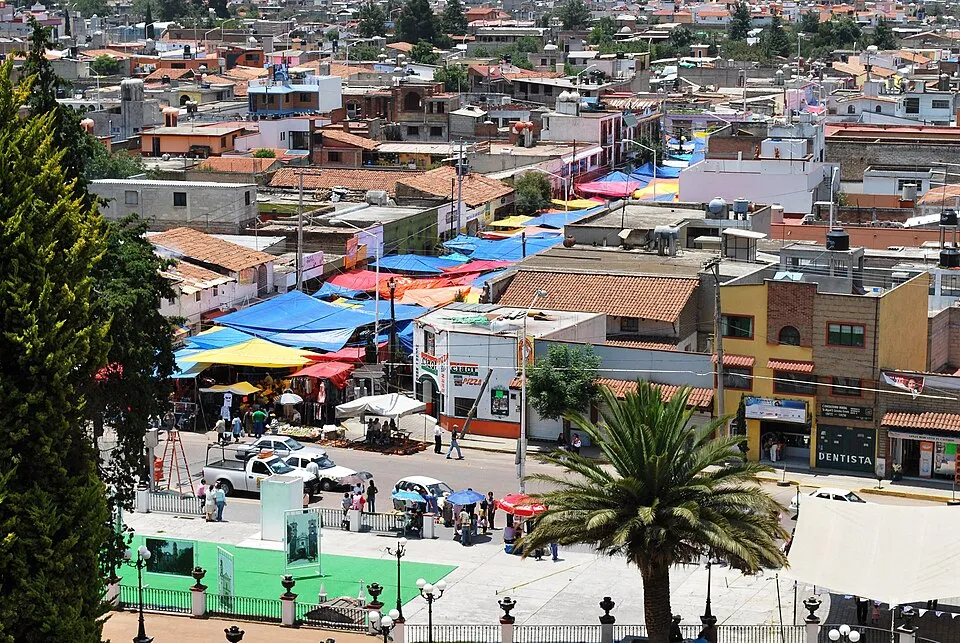
A tianguis demonstrates how urban space can operate on a schedule. On market day, vendors convert streets or open areas into temporary commercial corridors using tables, tarps, carts and portable displays. Hours later, the infrastructure is dismantled and the same space returns to traffic, pedestrians or neighborhood life. [1][3]
The form has historical depth without being a frozen survival from the past. UNAM accounts connect public market exchange in Mexico with Mesoamerican traditions, while contemporary tianguis function inside modern cities, regulations and consumer economies. Continuity lies in recurring public trade, not in the claim that today's markets are identical to pre-Hispanic ones. [2]
Their flexibility supports remarkable variety. Mexico City's San Felipe de Jesús Sunday tianguis is particularly associated with sportswear and footwear, but official city information describes a much broader range of goods. Other markets may specialize in food, plants, antiques, clothing or everyday household items. [1][3]
Temporary commerce lowers the importance of permanent retail architecture. A vendor's business can consist of inventory, transport, relationships and a regular place in the weekly layout rather than a conventional storefront. The market's “building” is assembled repeatedly through collective routine.
That routine also produces social infrastructure. Regular shoppers learn which sellers to trust, neighbors encounter one another, and price comparison happens through direct conversation. Economic exchange is embedded in a public setting where browsing and social contact overlap.
The arrangement creates tensions as well. Streets are finite resources, and successful tianguis must coexist with transport, sanitation, residents and other uses of public space. Their informality of appearance should not be confused with an absence of organization.
What makes the tianguis distinctive is this repeated transformation. Commerce arrives almost like an event, occupies the neighborhood intensely, and then withdraws. The market exists partly in physical space and partly in collective memory: everyone knows where it will return and when.
Discussion Questions
- What does the tianguis reveal about the value of allowing public spaces to change function over time?
- How can cities regulate temporary commerce without destroying the flexibility that makes it useful?
- Why do long-running market traditions persist even when supermarkets and online shopping are widely available?
- How does repeated face-to-face exchange create forms of trust that differ from anonymous retail?
- What elements of historical continuity can be claimed responsibly when a modern practice has ancient roots?
References
Finished reading? Mark this lesson as done.