Exercise Without a Gym: South Korea's Outdoor Fitness Machines
Key Vocabulary
public exercise machines installed outside, often in parks or beside walking paths
Outdoor fitness equipment is common beside some Korean walking routes.
a feature of the surroundings that encourages or reminds people to behave in a certain way
Visible exercise machines can act as an environmental cue for movement.
exercise in which muscles work against a force
The Korean study included resistance exercise.
a person's ability to perform movements and everyday physical tasks
The trial measured changes in physical function.
a planned series of activities with defined exercises, frequency or progression
Research results from a structured program may not apply to casual use.
Article
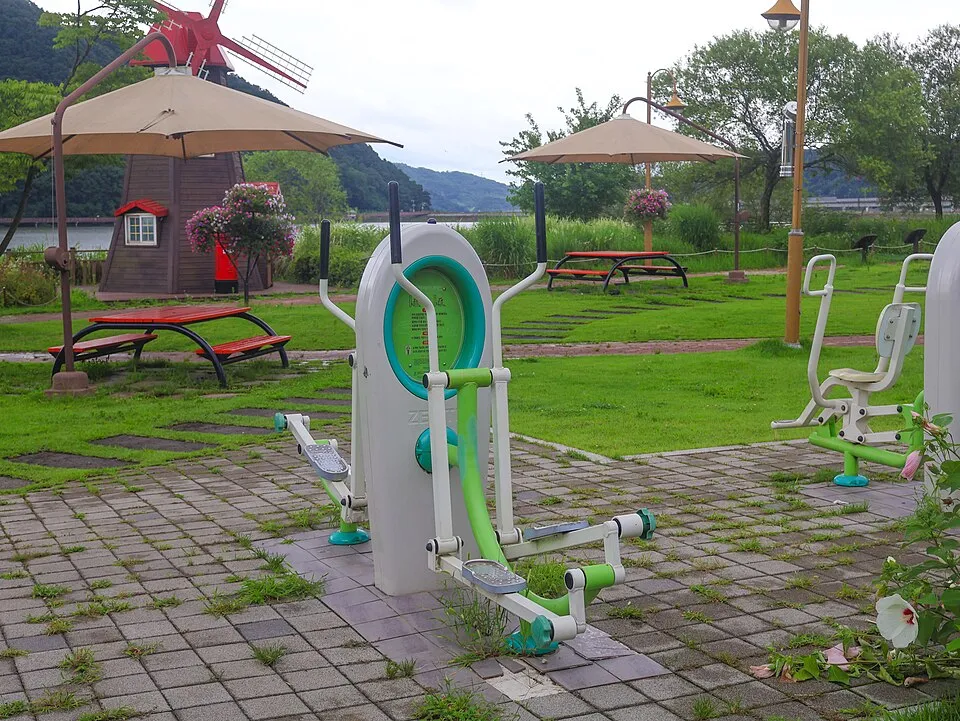
In many South Korean parks, exercise equipment sits in the open air with no reception desk, membership card or closing wall around it. Walkers can stop beside a path, use a twisting platform, press against resistance handles or work through simple strength movements, then continue on. Seoul's own park information describes outdoor fitness equipment as part of ordinary recreational landscapes, including the Songjeong Embankment Walkway. [1]
The machines occupy an interesting middle ground between infrastructure and exercise program. They are public objects, available without the rituals of joining a gym, and their location beside walking routes makes activity easy to combine with an existing routine. For older adults in particular, proximity and zero entry cost can matter as much as technological sophistication.
Research in Korea suggests that the equipment can support meaningful exercise when it is used systematically. A small randomized pilot trial involving 47 older adults tested six weeks of resistance exercise or combined aerobic-and-resistance exercise using outdoor machines. The exercise groups improved measures of muscular strength/endurance and physical function compared with controls, with additional metabolic changes reported in the combined group. [2][3]
The study should not be turned into a promise about every machine in every park. It involved a structured six-week program, a modest number of participants and specific exercises. Casual use without appropriate intensity, progression or technique is a different situation. [2]
That distinction matters because outdoor equipment can look self-explanatory. Simple diagrams may show the movement, but users still vary in mobility, strength, medical history and familiarity with resistance exercise. Equipment that is accessible in location is not automatically accessible in instruction.
Its strongest public-health value may therefore be environmental. A park that includes paths, benches and exercise stations offers several levels of activity in the same setting. Someone can walk, rest, try a machine briefly or build a more deliberate routine without entering a specialized fitness facility. [1]
South Korea's park gyms illustrate a broader design question: how much exercise should cities make available as part of ordinary public space? The machines cannot coach, motivate or prescribe a safe program by themselves. What they can do is place the possibility of movement directly in people's path, turning exercise from a destination into something encountered on the way.
Discussion Questions
- Can placing exercise equipment in ordinary public space meaningfully change population activity levels, or is motivation still the main barrier?
- What design features would make outdoor fitness equipment genuinely useful to older adults rather than merely decorative?
- How should cities provide instructions or supervision without making free public exercise feel overly controlled?
- Why is it important to distinguish evidence from a structured exercise trial from casual use of the same equipment?
- What other health-supporting activities could urban planners make easier simply by placing facilities in people's daily paths?
References
- Seoul Metropolitan Government, "Songjeong Embankment Walkway." Source
- Kim et al., "Six weeks of combined aerobic and resistance exercise using outdoor exercise machines improves fitness, insulin resistance, and chemerin in the Korean elderly," Archives of Gerontology and Geriatrics. Source
- Yonsei University, "Six weeks of combined aerobic and resistance exercise using outdoor exercise machines improves fitness, insulin resistance, and chemerin in the Korean elderly." Source
Finished reading? Mark this lesson as done.