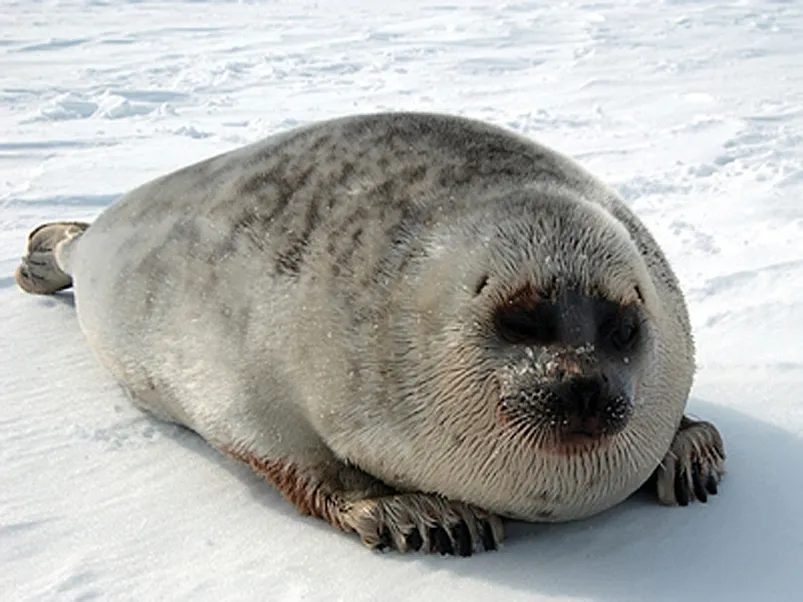
Food or Fear? How Ringed Seals Navigate a Changing Arctic
Key Vocabulary
the likelihood that an animal will be attacked by a predator
The seals changed their behavior when predation risk increased.
searching for and obtaining food
Animals must balance successful foraging with personal safety.
the idea that relying on a variety of resources can reduce overall risk
The researchers used the portfolio effect to explain the value of diverse food.
a situation in which two things occur in the same place or time
The study examined the overlap between feeding areas and polar-bear activity.
a relationship between organisms or between organisms and their environment
Climate change can alter many ecological interactions at once.
Article
Ecologists often map habitat by asking where animals can find food. A study from the University of British Columbia suggests that this is only half the problem. For ringed seals in eastern Hudson Bay, a productive feeding area can simultaneously be a landscape of opportunity and a landscape of fear. [1]
Researchers tracked 26 ringed seals and 39 polar bears using GPS and dive data, then combined those movements with daily sea-ice information and models of fish-species diversity. This allowed them to examine not merely where seals traveled, but how their behavior changed as food opportunities and predation risk overlapped. [1][2]
The broad pattern was unsurprising: seals tended to avoid locations with intense polar-bear activity and moved through risky areas relatively quickly. Yet food diversity complicated that response. Where the available fish community was especially varied, seals made longer dives even in polar-bear hotspots. [1]
The researchers interpret this partly through a biological version of portfolio theory. Depending on several potential food sources can reduce the risk of finding nothing when environmental conditions change. A diverse menu may therefore justify accepting a greater short-term danger from predators.
The finding challenges a simple idea of good habitat. An area rich in prey may not be attractive if predators make feeding too costly, while an apparently dangerous area may still be valuable when food opportunities are sufficiently strong. Conservation maps that consider only resources can therefore miss how animals actually use a landscape.
Climate change increases the importance of these interactions. Ringed seals depend on sea ice for reproduction, while changing ice conditions can alter the movements and accessibility of both seals and polar bears. [3] Ecological change is therefore not a sequence of isolated effects but a reshuffling of relationships.
The study offers a useful reminder about animal behavior: survival is rarely about maximizing one thing. Animals continually negotiate competing needs. For a ringed seal, the question is not simply where the fish are, but whether tonight's menu is good enough to justify swimming beneath a hungry bear.
Discussion Questions
- How does including predators change the way conservationists should define valuable habitat?
- What does this research suggest about the difference between having abundant food and having usable food?
- Why can climate change be difficult to understand when many species respond to one another?
- What other animals might make similar trade-offs between food quality and safety?
- How useful are comparisons between animal risk-taking and human decisions about reward and danger?
References
- University of British Columbia, "Seals risk death by polar bear for a varied meal, UBC study finds." Source
- Florko et al., "Predator and prey landscapes interact with prey diversity," Ecology Letters. Source
- Fisheries and Oceans Canada, "Researching the impacts of climate change on marine mammals." Source
Finished reading? Mark this lesson as done.