From Crackly Radios to Online Classrooms: Australia's School of the Air
Key Vocabulary
Education provided to students who are not physically present in a normal classroom.
Distance education allows children in remote areas to study from home.
Far away from other people, towns or services.
Some students live on isolated properties.
Communication in which both sides can send and receive information.
Two-way communication allowed students to answer their teacher by radio.
Communication or study materials exchanged over distance, traditionally by mail.
Early students received correspondence materials to complete at home.
Separation from other people or services because of physical distance or location.
Online classes help students overcome geographical isolation.
Article
Picture a classroom covering an area larger than many countries. The students cannot walk to the same school, and some may live hundreds of kilometres from their classmates. In remote Australia, this problem helped create one of the country's most distinctive educational ideas: the School of the Air.
Western Australia currently operates five Schools of the Air, based in Carnarvon, Kalgoorlie, Derby, Meekatharra and Port Hedland. They serve children living in isolated communities while following the same Western Australian curriculum as students attending ordinary schools. [1]
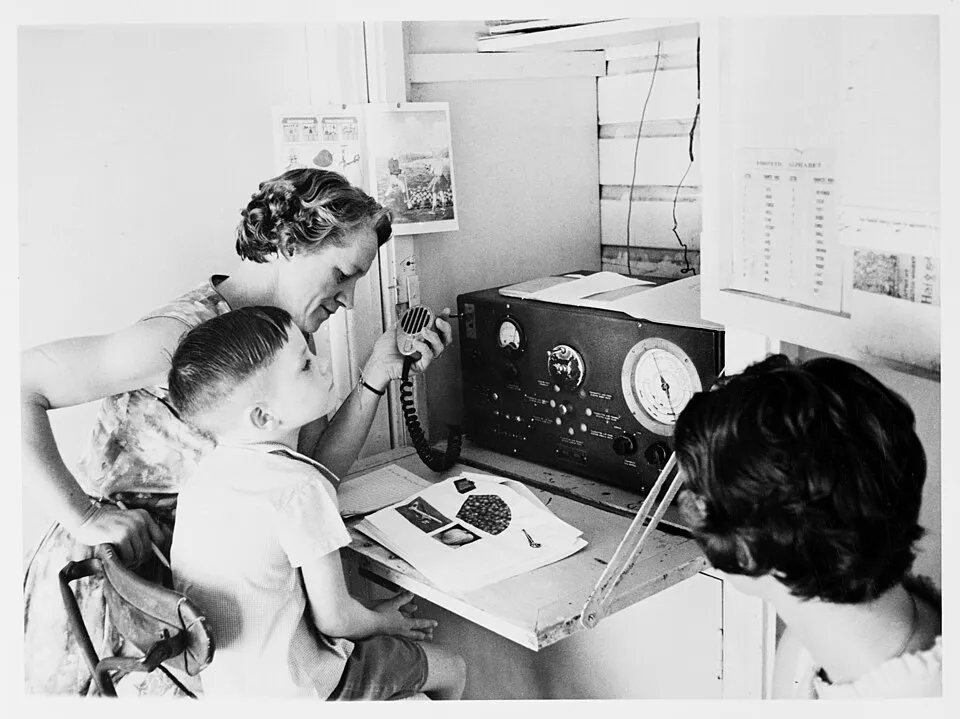
The technology was once dramatically different. After a successful trial in Carnarvon, Western Australia's first School of the Air opened in Meekatharra in 1959. Teachers used the Royal Flying Doctor Service's two-way radio network to reach 27 students scattered across an area of roughly 500,000 square kilometres. [2]
For up to three hours a day, a teacher could transmit from a small classroom while students listened and responded from distant homes. A microphone and radio connection turned cattle stations and isolated properties into parts of the same classroom. The signal may have crackled, but the lesson could still travel.
The original system combined live radio lessons with learning materials supplied by correspondence. Over the following decades, additional Schools of the Air opened in Derby, Port Hedland, Kalgoorlie and Carnarvon, creating a network designed around the realities of Western Australia's enormous geography. [2]
Today, distance education uses very different tools. Students can receive course materials at home and take part in online classes with real-time, two-way communication. Digital technology allows teachers to share screens, speak directly with students and provide learning experiences that early radio teachers could only imagine. [1]
Yet the important idea has remained remarkably stable. School is not defined only by a building. It is also a relationship between teachers, students and a shared programme of learning. In isolated communities, communication technology simply has to stretch that relationship across a much larger map. [3]
The story of the School of the Air is therefore not mainly about radios becoming computers. It is about refusing to let distance decide who gets to join a classroom. The equipment keeps changing; the ambition behind it does not.
Discussion Questions
- How does geography affect education in remote parts of your country?
- Which parts of a classroom experience can technology reproduce well, and which are harder to reproduce?
- What would have been the most interesting part of learning by two-way radio?
- How might growing up in an isolated community influence a student's independence?
- What other public services could use technology creatively to reach people living far from cities?
References
Finished reading? Mark this lesson as done.