Can Social Prescribing Reduce Loneliness in England?
Key Vocabulary
Connecting people with community support for non-medical needs that affect health.
Her doctor suggested social prescribing after she became isolated.
A person who helps someone identify and access suitable community services.
The link worker introduced him to a local walking group.
Considering the whole person and several connected parts of life.
The service takes a holistic view of health and well-being.
A difficulty caused by wider social or economic systems.
A community activity cannot solve every structural problem.
The collection of research used to judge whether an approach works.
The evidence base for social prescribing is continuing to grow.
Article
A patient who repeatedly visits a doctor may not always need another medical test or prescription. The deeper problem might be loneliness, debt, insecure housing, unemployment or the loss of a meaningful routine.
England's social-prescribing model is designed for needs that affect health but cannot be solved by medicine alone. A healthcare professional can refer a person to a link worker, who discusses what matters to the individual and connects them with suitable local support. [1]
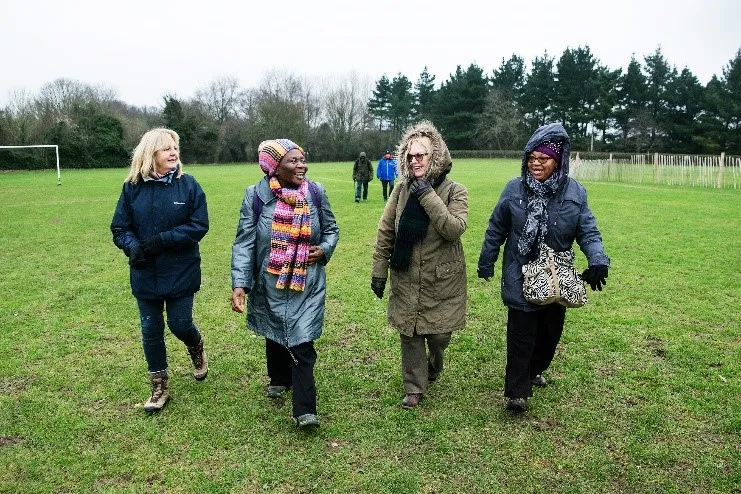
The resulting 'prescription' might involve a walking group, gardening project, art class, volunteering opportunity, benefits adviser or service for carers. The choice should reflect the person's goals rather than a standard list of activities. [2]
This approach recognizes that health is shaped by social conditions. Isolation can worsen emotional well-being, while financial stress or poor housing can make it harder to manage a long-term medical condition.
Social prescribing is particularly relevant to healthy aging. Retirement, bereavement, reduced mobility and the closure of local services can gradually narrow an older person's social world. A supported introduction to a community activity may be easier than simply advising someone to 'get out more.'
Link workers can help with practical barriers such as anxiety about joining a group, transport difficulties or uncertainty about eligibility. They may also introduce a person to several forms of support rather than treating one issue in isolation. [2]
Government guidance argues that social prescribing can build social connections and may reduce pressure on general practitioners by directing people toward more appropriate forms of help. However, reported benefits vary, and not every local service has the same resources or quality. [3]
Evidence reviews suggest that link-worker schemes and community activities can reduce loneliness for some participants, especially when social and psychological support are combined. The evidence base is still developing, and results should not be treated as proof that every referral will succeed. [4]
The model also depends on voluntary and community organizations. Referring more people to a gardening club or advice centre is not sustainable if the group lacks staff, funding or accessible facilities.
There is also a risk of presenting social prescribing as a cheap replacement for professional healthcare or public services. Community connection can support health, but it cannot remove structural problems such as poverty, inadequate housing or long waiting lists.
The strongest version of social prescribing does not claim that friendship is medicine. It accepts that human problems often cross the boundaries between health, work, money and community, and that useful care may begin by asking a broader question than 'What is wrong with you?'
Discussion Questions
- Which non-medical problems commonly affect people's health in your country?
- What community activity could a doctor appropriately recommend where you live?
- How should health systems judge whether social prescribing is successful?
- What responsibilities should belong to healthcare providers, and what should remain with community organizations?
- How can societies reduce loneliness without treating every lonely person as a patient?
References
Finished reading? Mark this lesson as done.