Arnis Between Heritage and Competition
Created by Brando Oxley · 25 Aug 2026
Key Vocabulary
a broad label used to include several related names, styles or practices
Arnis can function as an umbrella term for related Filipino martial traditions.
the process of creating common rules, forms or measures
Competition requires a degree of standardization.
a contest whose potentially dangerous actions are controlled by formal sport rules
Protective equipment turns stick fighting into a regulated sporting encounter.
an additional system or organization that shapes how an activity is practiced
School PE adds another institutional layer to arnis.
a cultural practice that continues to be used and changed by people today
Arnis remains a living tradition rather than only a historical artifact.
Article
Arnis occupies an unusual institutional position in the Philippines: it is simultaneously a family of indigenous martial traditions and an officially designated national sport. Republic Act No. 9850 formalized that status in 2009, using 'arnis' as an umbrella term that also acknowledges names such as eskrima and kali. [1]
Legal recognition inevitably simplifies a diverse practice. Martial traditions develop through instructors, regions and lineages, while a national sport needs common terminology, competition categories and rules that allow athletes from different backgrounds to meet under the same system.
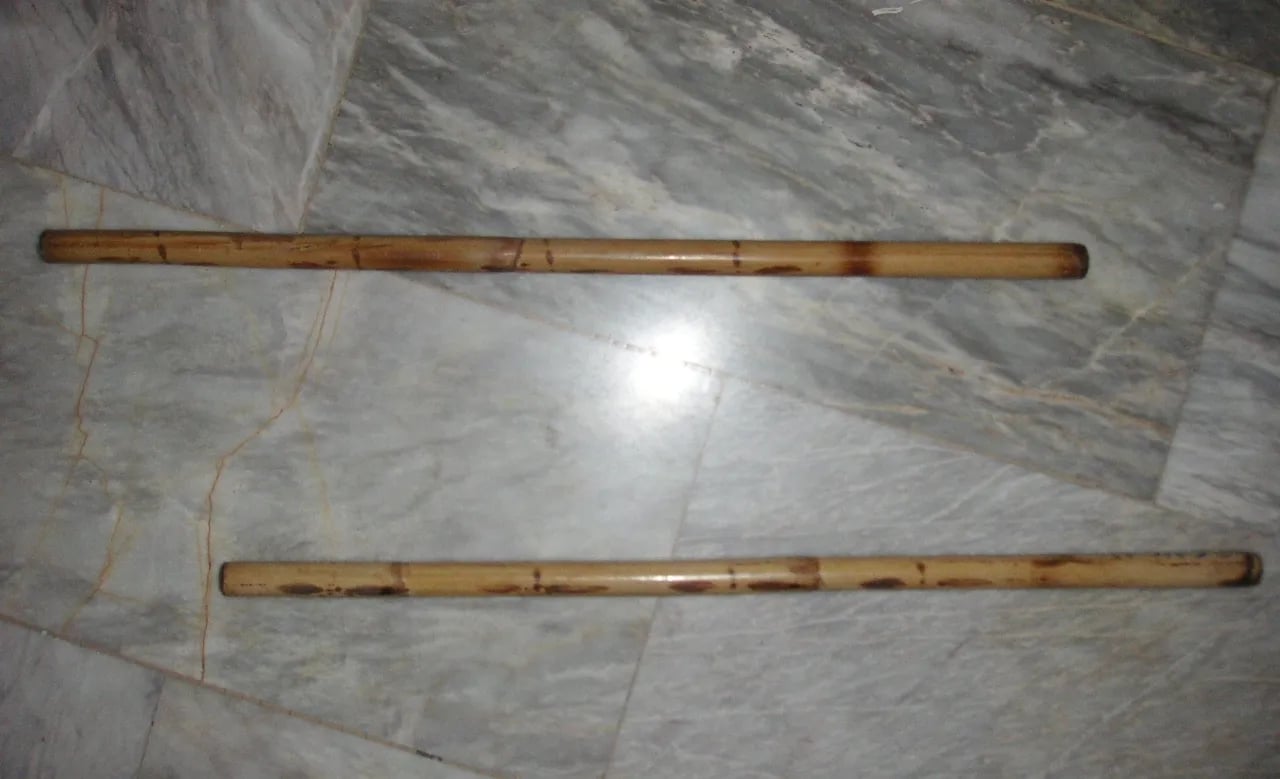
That process is visible in formal competition. Philippine National Games technical guidelines distinguish full-contact events from forms competition and specify equipment, bout structure and officiating. Full-contact matches can use padded or live sticks with protective equipment across three one-minute rounds, converting potentially dangerous techniques into a regulated sporting encounter. [4]
Anyo provides a different route to standardization. Athletes perform choreographed sequences rather than exchange strikes with an opponent, allowing judges to evaluate technical execution, control and presentation. Competition therefore extracts particular features of the martial art and makes them comparable.
School instruction adds another institutional layer. Department of Education resources place arnis inside physical education, where the objectives include learning the sport's background and skills while connecting practice to fitness qualities such as power, agility, speed and reaction time. [2][3]
This educational framing can broaden access, but it also changes purpose. A traditional martial art may transmit self-defense, identity, discipline and teacher-student relationships; a school lesson has limited time, age-appropriate safety requirements and curriculum outcomes. What survives the transition depends on what educators choose to emphasize.
The tension is not necessarily a flaw. Standardization can create national competitions, clearer safety procedures and a shared entry point for beginners, while local schools and instructors can preserve techniques and meanings that do not fit neatly into a tournament rulebook.
Arnis therefore illustrates how living traditions change when states, schools and sports organizations adopt them. National recognition gives the practice visibility, but recognition is only the beginning. The longer challenge is allowing a standardized sport to grow without convincing people that one official format represents the whole martial tradition.
Discussion Questions
- What is lost when an umbrella term is used for several distinct martial traditions?
- How much standardization is necessary before a martial art can function as a national competitive sport?
- Can a regulated sporting encounter preserve the meaning of a combat tradition?
- How does school education change a living tradition when it adds a new institutional layer?
- What should national sports bodies do to ensure official rules do not erase local styles?
References
- Supreme Court E-Library, "Republic Act No. 9850." Source
- Department of Education Learning Portal, "Self-Learning Module – Quarter 2 – Physical Education: Grade 7, Modules 1–3." Source
- Department of Education Learning Portal, "DLP in Health Optimizing Physical Education (H.O.P.E.) 2: Arnis." Source
- Philippine Sports Commission, "Arnis – Philippine National Games Technical Guidelines." Source
Finished reading? Mark this lesson as done.