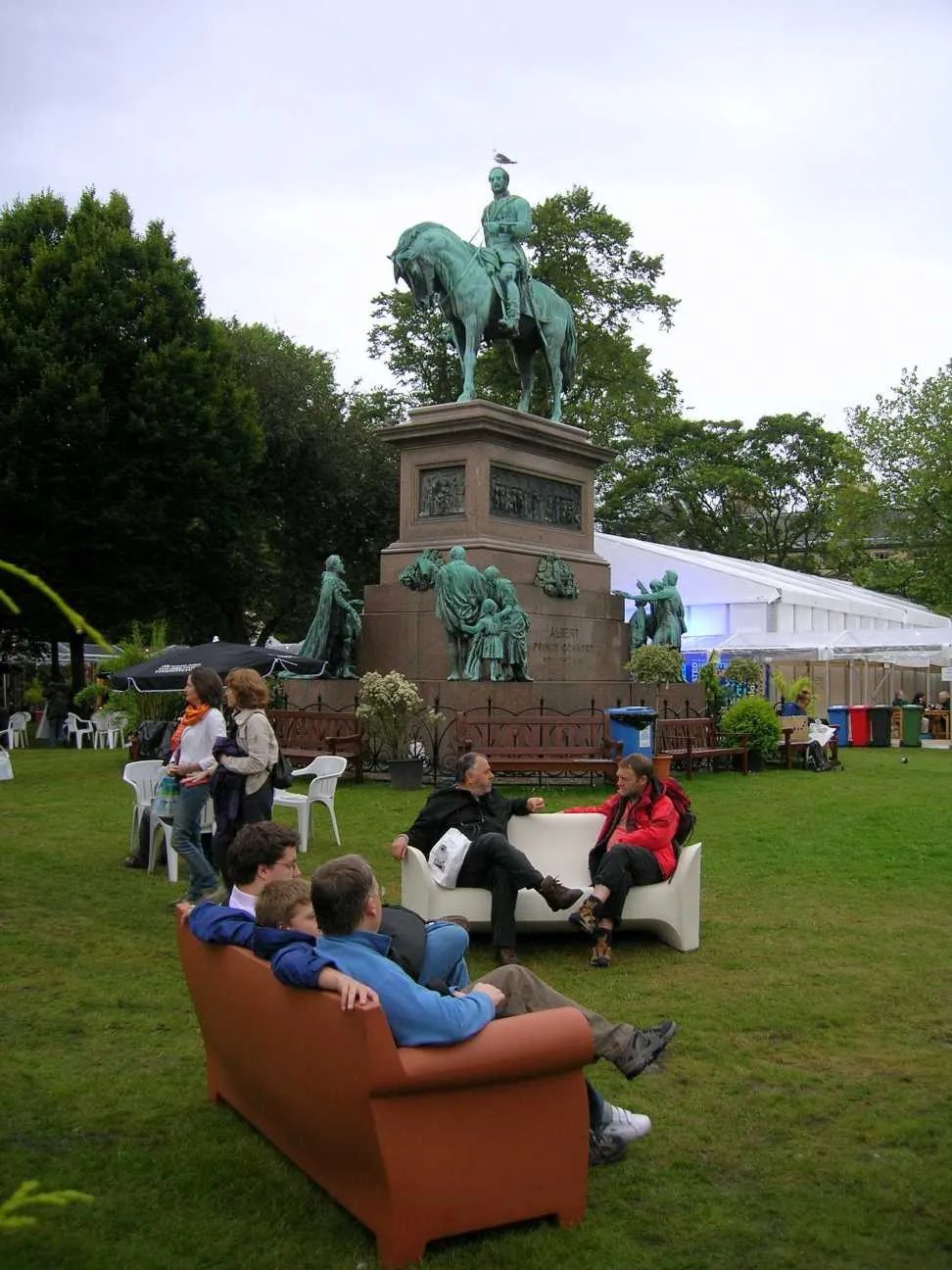
When Reading Leaves the Sofa: Edinburgh's Festival of Ideas
Created by Brando Oxley · 22 Aug 2026
Key Vocabulary
a central idea that shapes how people think about a subject
The theme provides an intellectual frame for the programme.
to think about a decision or opinion again
The discussion made me reconsider my first reaction.
a place or event where people openly discuss ideas
The festival acts as a public forum for writers and readers.
a particular way of understanding something
Her interpretation of the novel surprised the audience.
the quality of using more time or effort than seems necessary
The apparent inefficiency of meeting in person can create richer conversation.
Article
Reading is often imagined as a private arrangement between one person and a page. Edinburgh spends part of every August proving that assumption incomplete. From 15 to 30 August 2026, the Edinburgh International Book Festival is staging roughly 600 events with writers from 41 countries. [1][2]
The programme's theme, “Changing Your Mind,” gives the festival a timely intellectual frame. It encourages curiosity, deep listening and a willingness to reconsider positions rather than treating public discussion as a contest in which someone must immediately win. [3]
The format is broader than conventional literary interviews. Fiction sits beside politics, science, history, music, food and performance, while authors share stages with thinkers and artists from other fields. The result is less a trade fair for books than a temporary public forum built around them. [1][2]
Its setting reinforces that idea. The Edinburgh Futures Institute hosts the festival in the middle of a city already transformed by multiple August arts events. Visitors may move from a theatre performance to an author conversation and then into a crowded café where the discussion continues informally.
This social dimension changes what a book can do. A solitary reader may interpret a novel one way; an audience can expose that interpretation to disagreement, personal experience and unexpected questions. The author, too, loses some control once the work enters a room full of readers.
There is something appealingly inefficient about gathering hundreds of people to discuss objects designed to be read one at a time. Yet that inefficiency is precisely the point. The festival creates space for ideas to collide slowly enough that someone might actually leave with a different thought from the one they brought in.
Discussion Questions
- When has a public discussion caused you to reconsider an opinion?
- What makes a cultural event a meaningful public forum rather than simply entertainment?
- How can hearing other readers' interpretations change the way you understand a book?
- Do you think in-person literary festivals remain valuable when authors and readers can meet online?
- What kinds of productive inefficiency are worth protecting in modern life?
References
Finished reading? Mark this lesson as done.