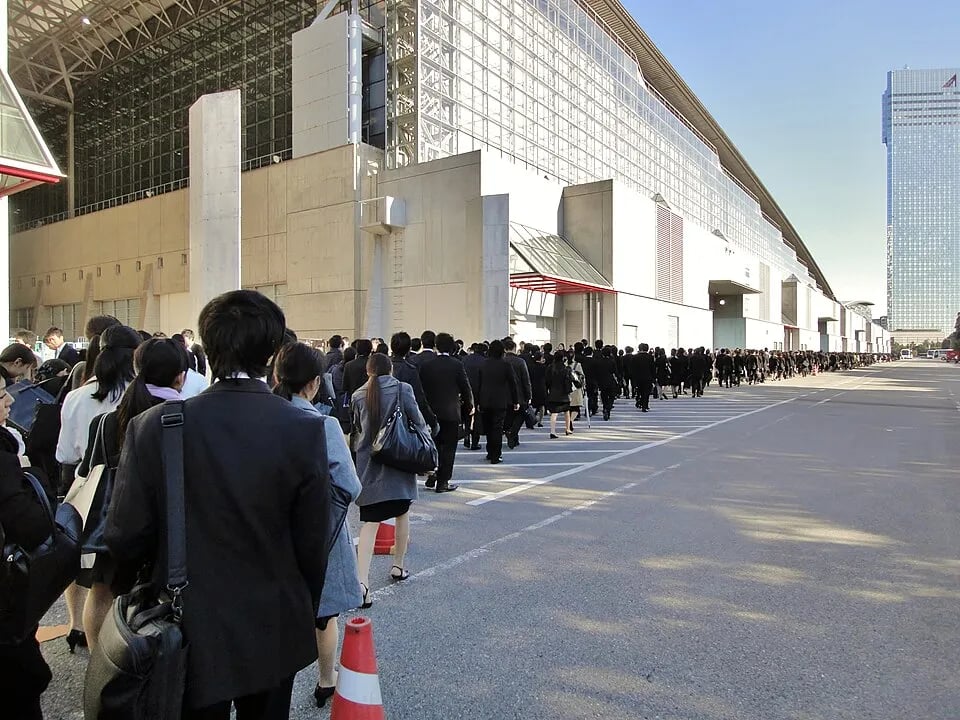
Japan's New-Graduate Job Hunt Starts Before Graduation
Created by Brando Oxley · 23 Aug 2026
Key Vocabulary
recruiting many new workers together during the same period
Many Japanese companies use bulk hiring for new graduates.
a written application form used by many Japanese companies
She spent several hours preparing her entry sheet.
a test used to measure abilities or skills for work
The company asked applicants to take an aptitude test.
a meeting in which an employer asks an applicant questions
He completed three rounds of interview meetings.
an early indication that a company plans to hire an applicant
She received a preliminary offer before graduation.
Article
For many Japanese university students, looking for a first full-time job begins well before graduation. Japan has a system of bulk hiring in which many companies recruit new graduates on a similar annual schedule while the students are still at university. [1]
Students usually begin with self-analysis and company research. When applications open, many employers ask for an entry sheet, a written form that includes information about the student, their experiences and their reasons for applying. [2][3]
Another common step is an aptitude test. Depending on the employer, tests can include language, mathematics or other questions designed to measure knowledge and abilities. Students may apply to several companies and prepare for different selection processes at the same time. [1][3]
Interviews follow. The Study in Japan guide notes that companies often conduct several interviews rather than making a decision after one meeting. Students may speak with different employees or managers as they move through the process. [1][3]
A successful candidate may receive a preliminary offer before graduation. Many Japanese universities finish their academic year in March, and new graduates commonly enter their companies on 1 April. This creates a clear connection between the school calendar and recruitment. [1][2]
The system can be especially unfamiliar to international students because missing the main recruitment period may reduce the number of opportunities available. JASSO therefore provides detailed job-hunting guidance for students planning to work in Japan. [4]
Bulk hiring makes the transition from university to employment highly organized, but it also means students may be thinking seriously about work while they are still completing their studies. The final university year can therefore feel like both an ending and an early start.
Discussion Questions
- How does bulk hiring compare with graduate recruitment in your country?
- What information should a good entry sheet include?
- Which abilities should an aptitude test measure for your profession?
- How many interview rounds seem reasonable before a company makes a decision?
- What are the advantages and disadvantages of receiving a preliminary offer before graduation?
References
Finished reading? Mark this lesson as done.