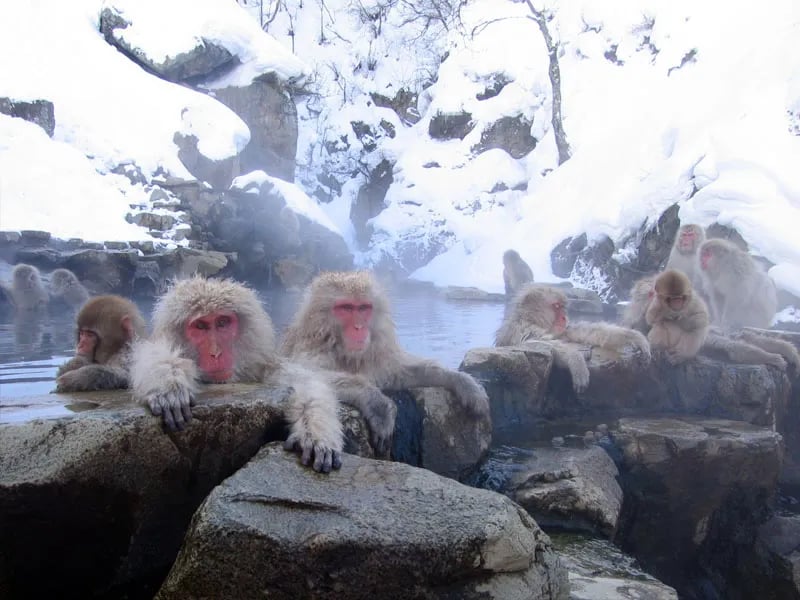
Learned Warmth: How Jigokudani Macaques Made a Hot Spring Their Own
Created by Brando Oxley · 24 Aug 2026
Key Vocabulary
the biological control of body temperature
Researchers suspected that bathing helped thermoregulation.
done regularly as a normal habit
Some females became habitual winter bathers.
chemical products measured to estimate activity of stress hormones
The team measured glucocorticoid metabolites in fecal samples.
a ranking system within a social group
The social hierarchy affected access to the hot spring.
the spread of learned behavior through observation or social interaction
The bathing habit offers an example of cultural transmission.
Article
Japanese macaques are famous for tolerating colder climates than any other non-human primate, but one group in Nagano developed an unusually comfortable addition to the usual toolkit of thick winter fur: hot spring bathing. The behavior at Jigokudani is learned rather than ancient, having first been observed in a young female in 1963. [1]
Other macaques copied the behavior, and park managers eventually created a dedicated pool for them. Long-term observations reported that by 2003 roughly one-third of the group's females were habitual winter bathers, with young monkeys more likely to acquire the behavior when their mothers already used the hot spring. [1][3]
The obvious hypothesis was thermoregulation. If immersion in warm water reduces heat loss, a macaque should need less metabolic energy to maintain body temperature during a severe winter. Yet for decades, that explanation rested mainly on the fact that the animals bathed more frequently in cold weather. [1]
A 2018 study added physiological evidence. Researchers followed 12 adult females during spring and winter and measured fecal glucocorticoid metabolites as an indicator of stress. Bathing increased in colder weeks and was associated with lower stress-hormone levels. [1][2]
The social hierarchy introduced a trade-off. High-ranking females had privileged access to the hot spring and spent more time bathing, but they also engaged in more aggressive interactions. Their rank therefore provided access to an energy-saving resource while simultaneously creating social costs. [1]
Tourism offered another possible source of stress because around 500 visitors a day were present during the research period. The measured glucocorticoid levels, however, did not show an effect associated with tourist numbers, at least under the conditions of that study. [1]
The behavior is striking because it illustrates cultural transmission in an animal group. An environmental opportunity existed—the hot water—but one individual's experiment had to become socially visible before bathing could spread through the troop.
In that sense, the hot spring is more than a convenient heater. It shows how behavioral innovation can modify the way an animal experiences climate without requiring genetic change. A winter landscape remained cold; the macaques changed what they did inside it.
Discussion Questions
- How strong is the evidence that thermoregulation is a major reason for hot spring bathing?
- What does the spread of habitual bathing suggest about learning among macaques?
- How can a social hierarchy create both benefits and costs for high-ranking animals?
- What evidence is needed before describing an animal behavior as cultural transmission?
- Which environmental opportunities have allowed humans or animals to change behavior without biological evolution?
References
- Kyoto University, "Spa therapy helps Japan’s snow monkeys cope with the cold." Source
- Primates, "Beneficial effect of hot spring bathing on stress levels in Japanese macaques." Source
- American Journal of Primatology, "Hot spring bathing in Japanese macaques (Macaca fuscata): implications for behavioral thermoregulation." Source
Finished reading? Mark this lesson as done.