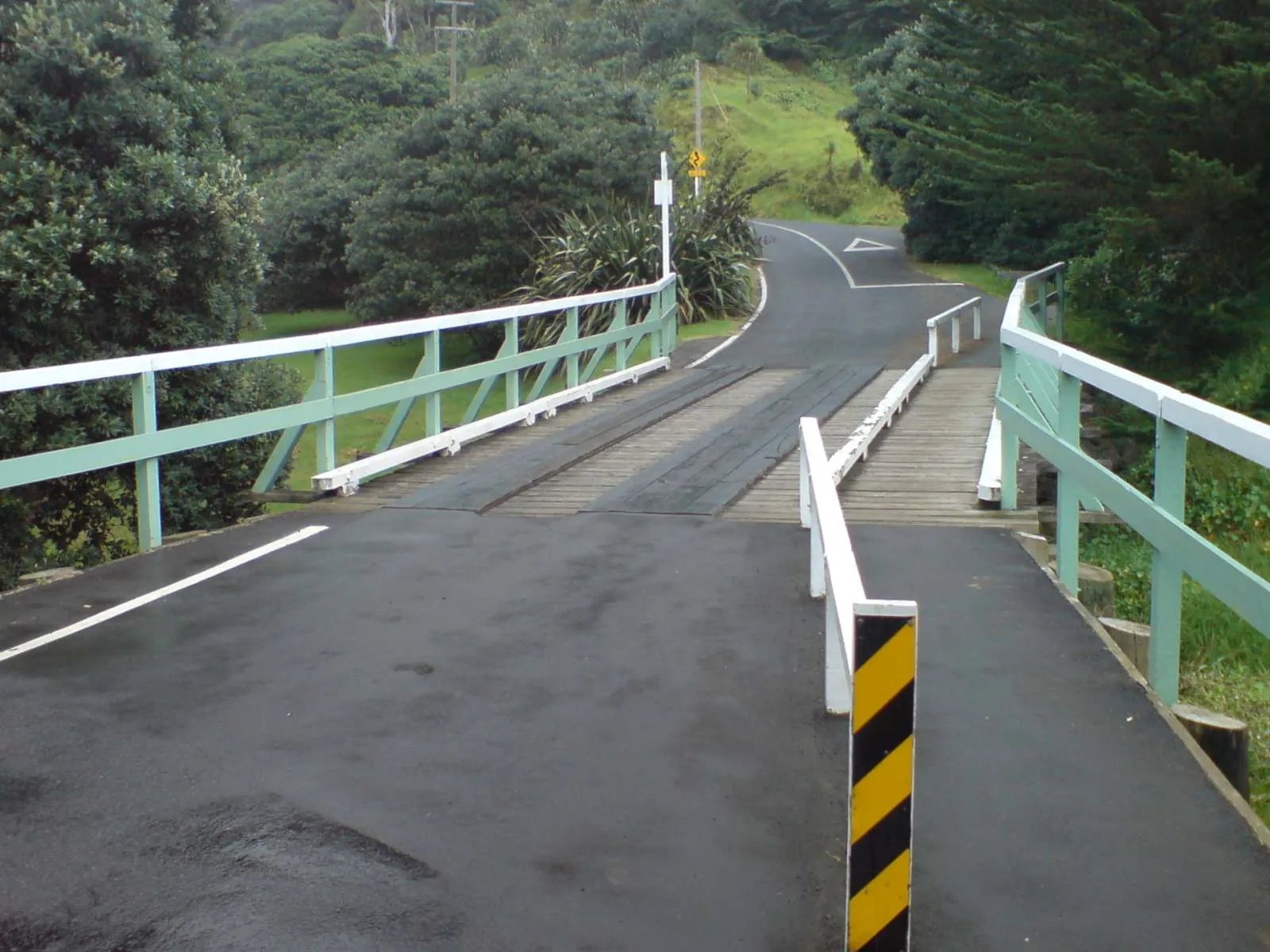
One Bridge, Two Directions: A New Zealand Road Legacy
Created by Brando Oxley · 22 Aug 2026
Key Vocabulary
a set of rules deciding which road users may go first
The bridge uses a priority system instead of two traffic lanes.
the movement of vehicles along a road or through an area
Heavy holiday traffic flow can create long delays.
a narrow point that restricts movement and causes delays
The bridge became a seasonal bottleneck.
an older feature of a road system that remains from earlier design or development
One-lane bridges are part of New Zealand's road legacy.
what a driver assumes will happen based on familiar road rules and designs
Unusual signs can challenge driver expectation.
Article
A one-lane bridge turns an ordinary drive into a brief negotiation. New Zealand still has bridges where opposing vehicles cannot pass simultaneously, so the road itself assigns a priority system before either driver reaches the narrow span. [1][2]
The signs are compact but precise. A red-bordered symbol instructs one direction to yield to oncoming vehicles; a blue sign tells the other direction that it has priority, provided the bridge is clear. Drivers are still expected to slow down and assess the situation rather than treating priority as an absolute command to proceed. [1]
This arrangement reflects a road legacy shaped by geography, older infrastructure and traffic volumes. A narrow bridge can remain functional for decades when demand is modest, even if it would look unusual on a newly built high-volume highway.
Problems emerge when traffic flow outgrows the design. NZTA's account of the former Kāeo Bridge describes a one-lane crossing that became a seasonal bottleneck, with visitors sometimes unfamiliar with the give-way system. Its replacement aimed to improve safety and reduce queues. [3]
The example shows how driver expectation matters. Local motorists may read the signs almost automatically, while a visitor can spend crucial seconds trying to understand which arrow represents whom. A rule can be perfectly logical and still feel unfamiliar.
One-lane bridges also make road behavior unusually visible. Courtesy, hesitation and impatience all become obvious because two streams of traffic are negotiating a single piece of space. The infrastructure quietly forces drivers to acknowledge one another.
As New Zealand replaces some older crossings, the remaining bridges continue to represent a distinctive compromise between cost, geography and movement. For the driver, however, the immediate task remains wonderfully uncomplicated: read the sign, check the bridge and make sure only one direction occupies it at a time.
Discussion Questions
- How should authorities decide when a useful road legacy has become outdated?
- Why can driver expectation create safety problems even when signage is technically clear?
- What solutions can improve traffic flow without immediately replacing a bridge?
- When does a narrow crossing become an unacceptable bottleneck for a community?
- What transport feature in your country requires visitors to learn a local way of doing things?
References
Finished reading? Mark this lesson as done.