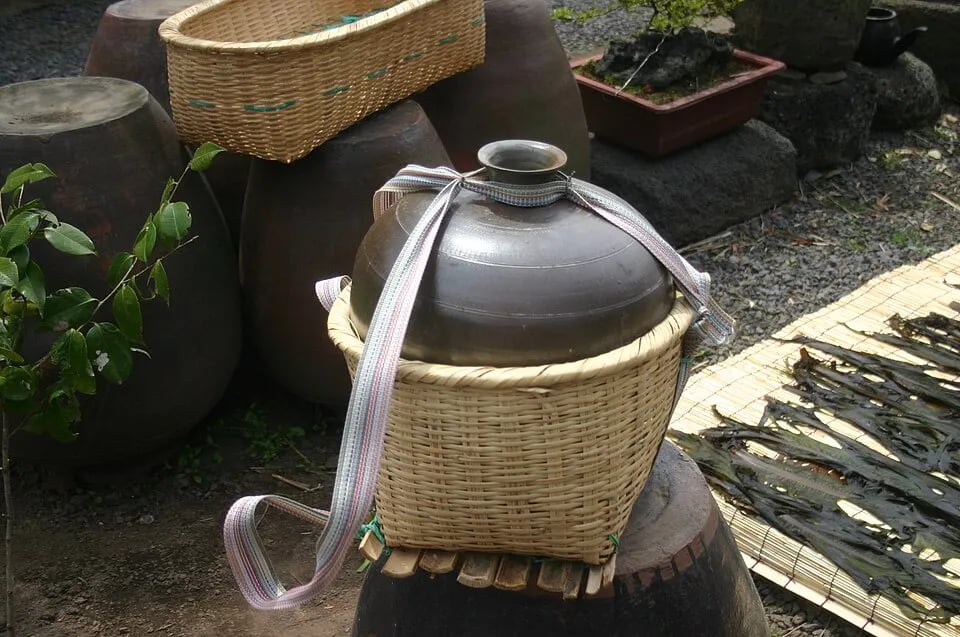
How Tiny Pores Make Korea's Onggi a Fermentation Tool
Created by Brando Oxley · 23 Aug 2026
Key Vocabulary
the ability of a material to let a fluid or gas pass through it
The researchers measured the gas permeability of the clay.
containing many small connected openings
Onggi has a porous structure.
a biological process in which microorganisms transform food or other material
Carbon dioxide increased during fermentation.
a gas produced by many microorganisms during biological processes
Carbon dioxide moved through the jar wall.
an unwanted substance or organism that can enter and affect something
Outward gas flow may reduce the entry of a contaminant.
Article
The reputation of Korean onggi as 'breathing' pottery sounds poetic, but its function can be described in physical terms. A 2023 study in the Journal of the Royal Society Interface examined the permeability of onggi walls and how that property changes the gas environment during fermentation. [1][2]
The researchers fermented salted napa cabbage in traditional onggi and in hermetically closed glassware. Rather than evaluating flavor, they measured carbon dioxide, a product of microbial activity, while characterizing the jars' porous structure with imaging and fluid-mechanics methods. [1]
The onggi contained interconnected pores ranging across microscopic sizes. Its permeability allowed carbon dioxide to move outward through the clay, keeping the internal concentration below the level found in glass. A mathematical model was then used to estimate how quickly the fermenting cabbage generated gas. [1]
According to that model, the cabbage in onggi generated about 26% more carbon dioxide during the 48-hour experiment. The authors interpreted this as evidence of greater bacterial proliferation under the conditions created by the jar. [1][2]
The outward flow may have another useful effect. The paper proposes that positive pressure inside the jar and continuous gas movement can reduce the entry of an external contaminant larger than the pores, functioning somewhat like a passive safety valve. [1]
The study does not establish that every traditional jar will behave identically. Onggi permeability depends on manufacturing details such as clay composition, firing temperature and glazing. The experiment also used salted cabbage rather than the full mixture of ingredients found in finished kimchi. [1]
Earlier food-science research had already reported differences in kimchi fermented in onggi compared with other containers. The newer work adds a possible physical mechanism by connecting microbial activity with the movement of gas through the jar itself. [4]
Onggi therefore offers an interesting meeting point between craft and engineering. Generations of potters created a useful fermentation vessel without measuring pore diameter or modelling gas flow; modern experiments can now describe some of the material behavior that helped make the vessel valuable.
Discussion Questions
- Why is permeability an important property for a fermentation vessel?
- How should researchers interpret a traditional claim such as pottery that 'breathes'?
- What limits should be considered before applying this experiment to all onggi?
- Why is identifying a physical mechanism valuable even when a traditional practice already works?
- What other craft traditions might benefit from scientific study without reducing their cultural value?
References
- Journal of the Royal Society Interface, "Onggi’s permeability to carbon dioxide accelerates kimchi fermentation." Source
- PubMed, "Onggi's permeability to carbon dioxide accelerates kimchi fermentation." Source
- Korea.net, "Onggi, traditional earthenware vessel in Korea." Source
- International Journal of Food Science & Technology, "Increased quality and functionality of kimchi when fermented in Korean earthenware (onggi)." Source
Finished reading? Mark this lesson as done.