What Table Tennis Experience May Mean for Motor Control in Older Adults
Created by Brando Oxley · 25 Aug 2026
Key Vocabulary
the ability of the brain and body to plan, start, change and stop movement
The study measured motor control in older adults.
the ability to stop or change an action after new information appears
Returning a fast ball requires strong reactive control.
a non-invasive research method that uses magnetic pulses to study brain activity and connections
Researchers used transcranial magnetic stimulation to examine motor pathways.
comparing different groups at one period rather than following changes over a long time
A cross-sectional study cannot easily show what caused a difference.
a relationship between two things that does not by itself prove cause
The research found an association between table tennis experience and better motor control.
Article
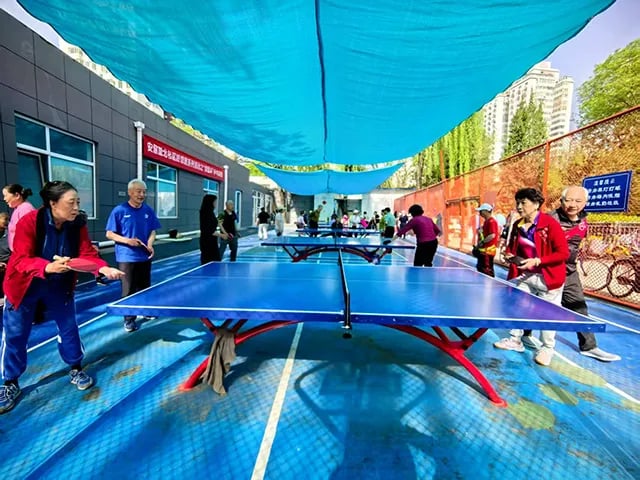
Table tennis asks the body to make constant small decisions: track a moving ball, predict its path, prepare a shot and sometimes stop or change an action almost immediately. Researchers in China studied whether older adults with long-term table tennis experience also showed differences in motor control. [1][2]
The study included 91 older adults in its final sample. Twenty-nine had table tennis experience, 31 had experience with fit aerobics and 31 formed a comparison group without those exercise backgrounds. The two exercise groups had practiced for years. [1]
Participants completed a stop-signal task. In some trials they prepared a response and then received a signal telling them to stop it. The researchers used reaction times and accuracy to measure reactive control, the ability to stop an action after new information appears. [1]
The table tennis group produced faster and more accurate responses on several measures than both the fit-aerobics and comparison groups. The researchers also used transcranial magnetic stimulation, or TMS, to examine connectivity between brain areas involved in planning and controlling movement. [1][3]
Those neural measurements showed stronger or more stable patterns of regulation in the table tennis group on some pathways. The authors suggest that an open-skill sport may repeatedly challenge the brain to adjust movement in response to unpredictable outside information. [1]
However, the design was cross-sectional. Researchers compared people who already had different exercise experience rather than randomly assigning older adults to years of table tennis. That means the findings show an association and cannot establish that table tennis caused the advantages. [1]
The authors call the results preliminary and recommend longitudinal research. A stronger test would follow people over time and examine whether beginning or continuing particular kinds of exercise changes motor control and neural connectivity.
For now, the study gives table tennis an interesting place in the healthy-ageing discussion. Its value may come partly from combining physical movement with rapid decisions, but the next step is to test whether the game itself produces the differences seen in experienced players.
Discussion Questions
- Why might an open-skill sport challenge reactive control more than a predictable exercise routine?
- What are the advantages and disadvantages of using transcranial magnetic stimulation in exercise research?
- Why is a cross-sectional design weaker for proving cause than a long-term experiment?
- What other factors could explain an association between table tennis experience and better motor control?
- What kind of study would convince you that table tennis itself helps preserve movement control with age?
References
- Wei et al., "Table tennis experience enhances motor control in older adults: Insights into sensorimotor-related cortical connectivity." Source
- PubMed, "Table tennis experience enhances motor control in older adults: Insights into sensorimotor-related cortical connectivity." Source
- International Journal of Clinical and Health Psychology, "Table tennis experience enhances motor control in older adults." Source
Finished reading? Mark this lesson as done.