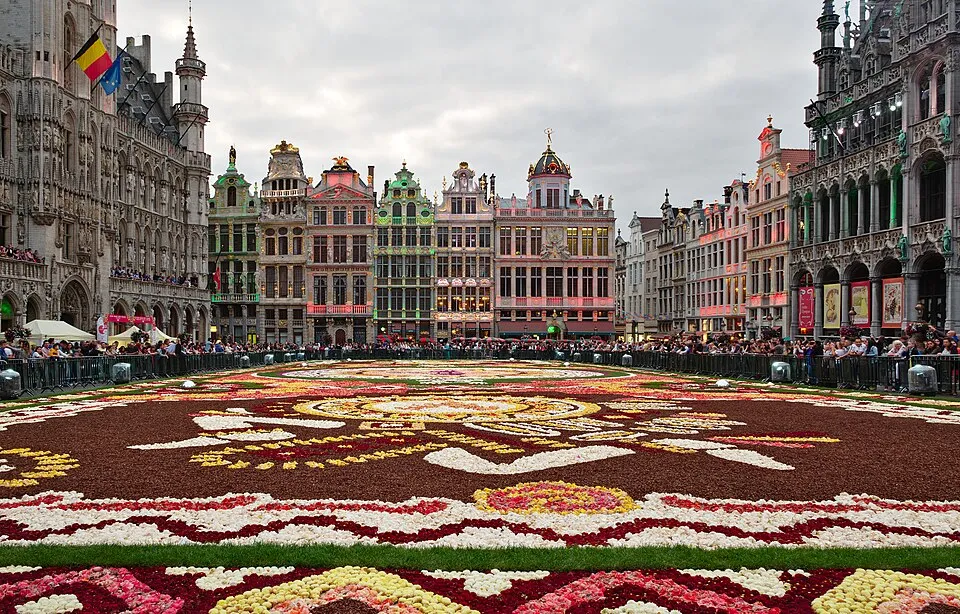
The Great Wave Blooms on Brussels' Grand-Place
Key Vocabulary
existing or popular for only a very short time
The Flower Carpet is intentionally ephemeral.
a new way of presenting or understanding an existing work or idea
The artist created a floral reinterpretation of Hokusai's print.
a work of art created for a particular space
The installation covers much of the Grand-Place.
the arrangement of elements within a work of art
The complete composition is easiest to see from above.
the sharing of ideas, traditions and artistic practices between cultures
The event is presented as a form of cultural exchange between Belgium and Japan.
Article
Brussels has temporarily transformed one of the world's best-known Japanese images into something far less permanent than a print. From August 13 to 16, the Grand-Place is covered by the 2026 Flower Carpet, whose design reinterprets Katsushika Hokusai's The Great Wave off Kanagawa. [1][2]
Japanese artist Hiro Sugiyama adapted the image for the enormous floral composition. His version retains recognizable elements such as the wave and Mount Fuji while combining them with a more contemporary visual language. [1]
The cultural exchange is deliberate. Japan is the guest of honour during a year marking 160 years of diplomatic relations between Belgium and Japan. The carpet therefore turns an internationally familiar Japanese artwork into a collaborative Belgian-Japanese public spectacle. [1]
Scale is central to the effect. The installation covers approximately 1,680 square metres of the historic square, using hundreds of thousands of closely packed flowers, particularly Belgian-grown dahlias. More than 100 volunteers carry out the final assembly in roughly six hours. [3]
The viewing experience changes throughout the day. At street level, visitors encounter individual flowers and sections of color without easily seeing the entire composition. A higher viewpoint from the Town Hall reveals the full picture, while evening sound-and-light shows transform it again. [2][3]
The event belongs to the tradition of ephemeral art: artworks whose disappearance is part of their identity. The flowers cannot remain fresh indefinitely, and the Grand-Place must soon return to its everyday function. Permanence would fundamentally change the character of the work.
Hokusai's original wave has survived for nearly two centuries and can be reproduced endlessly. Its Brussels descendant is designed to vanish in days. That contrast gives the familiar image an unusual urgency: this particular Great Wave can be seen only before several hundred thousand flowers begin to fade.
Discussion Questions
- What does an artwork gain or lose when it is designed to disappear?
- How should artists approach adapting an iconic work from another culture?
- Why can scale dramatically change the way an audience experiences a familiar image?
- What makes public art different from art displayed inside a museum?
- Which cultural partnership between two countries would produce an interesting artistic project?
References
Finished reading? Mark this lesson as done.