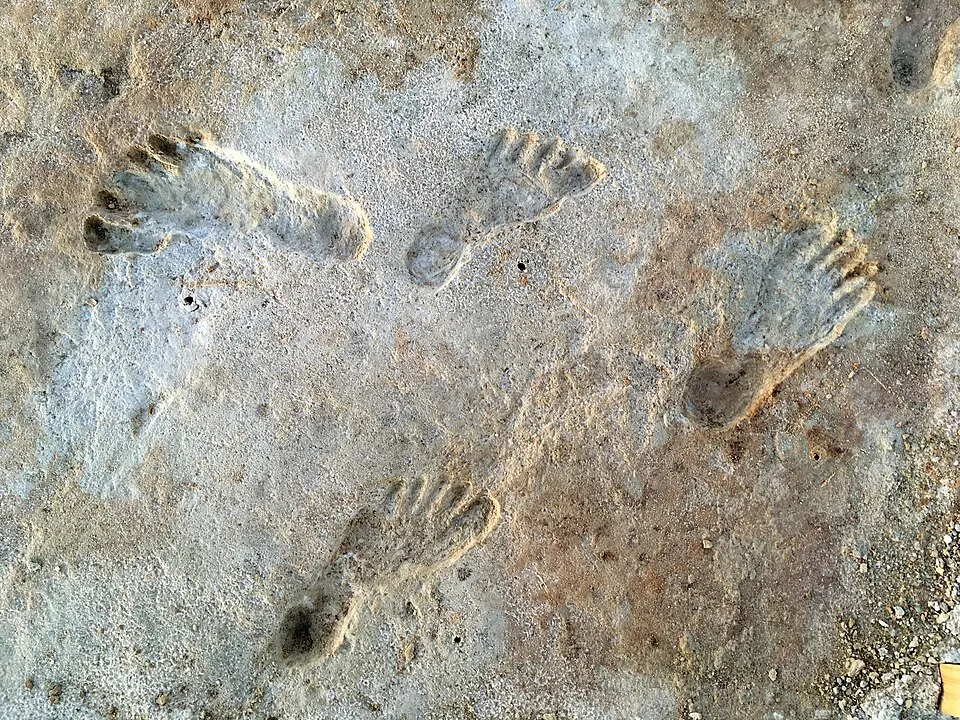
Ancient Steps at White Sands
Key Vocabulary
preserved naturally for a very long time
The fossilized footprints remain visible in the ancient lakebed.
sand, mud or other material deposited by water or wind
The tracks were preserved in layers of sediment.
separate and not relying on the same method or evidence
Researchers used two independent dating methods.
connected with land rather than water
The team tested pollen from terrestrial plants.
to estimate how old an object, layer or event is
Scientists used several methods to date the footprints.
Article
White Sands National Park in New Mexico contains fossilized human footprints preserved in what was once a lakeside environment. Some of the tracks have been dated to roughly 21,000 to 23,000 years ago, placing people in the region during the Last Glacial Maximum. [1][3]
The age attracted attention because older models often placed widespread human presence in North America much later. If the dates were correct, people were walking through New Mexico while huge ice sheets still covered parts of the continent.
The first dates came partly from seeds of an aquatic plant found around the footprints. Critics pointed out that water can contain old carbon, which might make aquatic material appear older than it really is. [1]
Instead of treating the debate as finished, researchers returned with two independent methods. They dated fossil pollen from terrestrial plants and used optically stimulated luminescence to estimate when quartz grains in the sediment had last been exposed to sunlight. [1][2]
Both approaches supported the original age range. USGS researchers said that three independent lines of evidence now point to the same general conclusion: humans were present at White Sands around 21,000 to 23,000 years ago. [1]
The story is a useful example of how science strengthens a surprising claim. Debate did not simply weaken the discovery; it pushed researchers to find better tests. The footprints remained in place while the evidence around them became more convincing.
Discussion Questions
- Why are surprising scientific claims often tested more carefully than ordinary ones?
- What makes several independent kinds of evidence more convincing than one method?
- What can footprints tell us that bones or tools might not?
- How should scientists communicate disagreement to the public?
- What discovery about early people would you most like archaeologists to make?
References
Finished reading? Mark this lesson as done.