Dating Deep Time: Why the White Sands Footprints Matter
Key Vocabulary
the arrangement or dating of events in time
The footprints challenge an older chronology of human settlement.
a dating problem in which organisms contain carbon older than the atmosphere around them
Scientists considered whether a reservoir effect had distorted the seed dates.
a dating method that estimates when mineral grains were last exposed to light
Optically stimulated luminescence provided an independent age estimate.
to support a claim with additional evidence
New dating methods helped corroborate the original result.
the period when global ice sheets reached their greatest recent extent
The tracks suggest humans were present during the Last Glacial Maximum.
Article
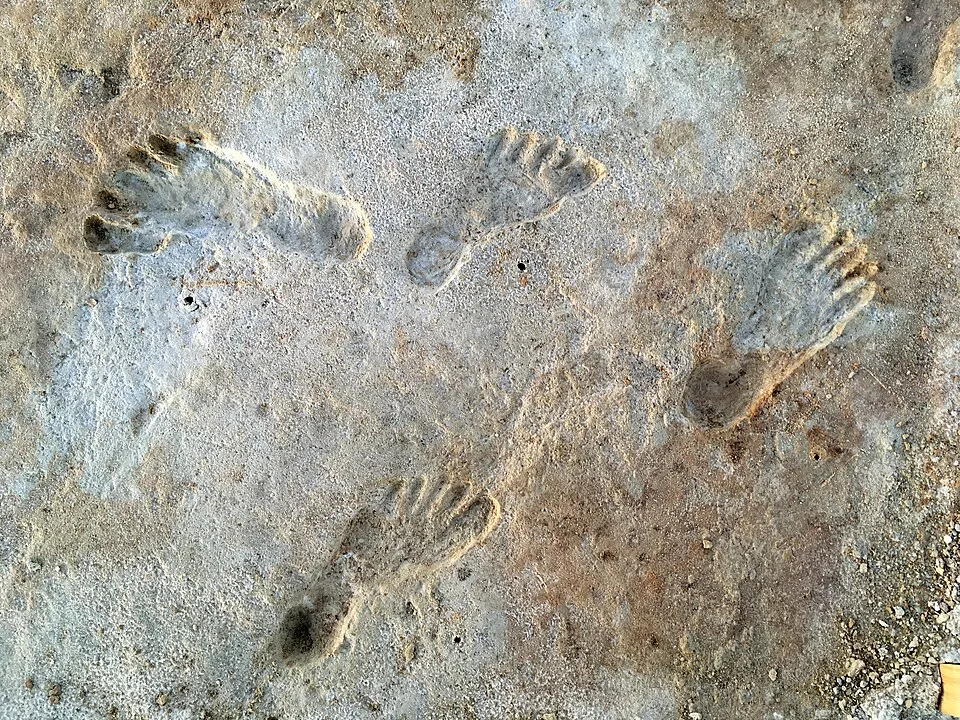
At White Sands in New Mexico, fossilized footprints have become evidence in one of North American archaeology's most consequential dating debates. The tracks appear to place humans in the region roughly 21,000 to 23,000 years ago, during the Last Glacial Maximum and thousands of years earlier than many older settlement models assumed. [1][3]
The original chronology relied partly on radiocarbon dates from seeds of Ruppia cirrhosa, an aquatic plant. Critics noted a potential reservoir effect: aquatic organisms can absorb carbon from sources older than the atmosphere, making samples appear artificially ancient. [1]
Researchers responded by seeking evidence that did not depend on aquatic material. One approach dated pollen from terrestrial plants. Another used optically stimulated luminescence, which estimates when quartz grains were last exposed to sunlight before burial. [1][2]
Both methods broadly agreed with the earlier result. USGS researchers concluded that three independent lines of evidence now support an age of about 21,000 to 23,000 years for the footprint-bearing layers. [1] Agreement across methods is especially important when a finding challenges an established historical timeline.
The tracks also offer a different kind of archaeological record. A tool may have been carried or reused; a footprint captures a brief act in a specific place. At White Sands, those moments survive as traces of people moving across a wet ancient landscape. [3]
The scientific value of the site therefore lies in both its antiquity and the process used to test it. Skepticism prompted stronger measurements rather than a retreat from the claim. The episode is a reminder that uncertainty is often productive: when an extraordinary date survives independent attempts to challenge it, the argument becomes more interesting, not less.
Discussion Questions
- How much independent evidence should be required before a surprising historical claim becomes widely accepted?
- Why is disagreement valuable when researchers are testing a major discovery?
- What are the strengths and weaknesses of using a brief trace such as a footprint as archaeological evidence?
- How should scientists explain technical dating uncertainty without making the public lose confidence?
- What other established ideas about human history might change if new evidence appears?
References
Finished reading? Mark this lesson as done.